

Key Takeaways
- Spa treatment room curtains create private, flexible zones without the cost of permanent walls, letting you reconfigure rooms for couples treatments, group services, or seasonal demand with a single track system. See our full range of commercial fabric curtains for options.
- The best curtain materials for spa environments are antimicrobial vinyl, washable polyester, and moisture-resistant fabrics that withstand steam, essential oils, and daily sanitization without degrading or holding odors.
- Medical spas and day spas that handle client health information should treat curtain privacy as part of their HIPAA reasonable safeguard obligation, where physical barriers like curtains satisfy the requirement without expensive facility renovations.
Updated: May 2026

Why Curtains Work Better Than Walls in Spa Treatment Rooms
Curtains give spa owners the ability to create, remove, and reconfigure private treatment zones on demand, at a fraction of the cost of permanent construction.
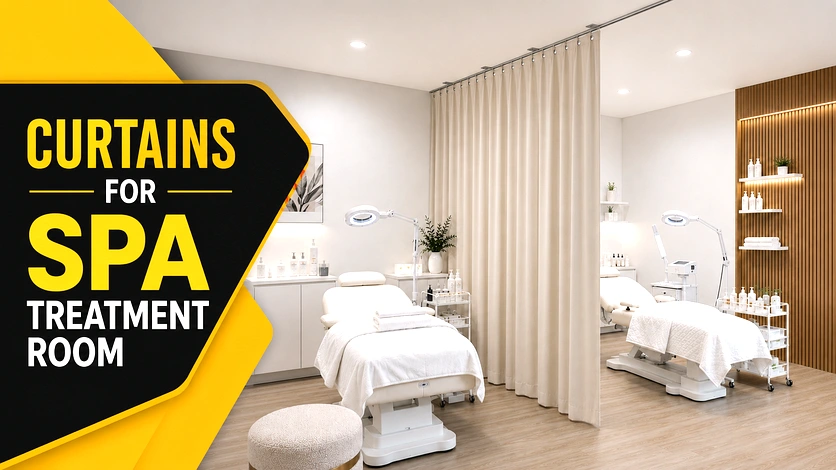
A fixed wall locks your floor plan into one configuration. If client demand shifts (more couples treatments in winter, more individual facials in summer) you cannot adjust. Curtain systems mounted on ceiling tracks solve this problem. One treatment suite splits into two private rooms in under 30 seconds. Two rooms open into a single large space for group bookings or training sessions. The curtains retract completely when not needed, preserving the open, calming feel that spa clients expect.
Cost is another factor. A standard stud wall with drywall, paint, and sound insulation runs $25 to $50 per linear foot in most markets. A ceiling-mounted curtain system with commercial fabric curtains typically costs 40% to 60% less than drywall construction and installs in hours rather than days. There is no demolition, no building permit in most jurisdictions, and no disruption to adjacent treatment rooms during installation.
Spas in leased commercial spaces benefit the most. Curtains are not a permanent fixture, so they can move with you when a lease ends. Drywall stays behind.
Track Systems and Mounting Options for Spa Layouts
The curtain track determines how the curtain moves, where it stores when open, and how much of the room it can divide. Ceiling-mounted tracks are the standard for spa treatment rooms.
Ceiling-Mounted Track
A ceiling-mounted aluminum or steel track is the cleanest installation for spa environments. The track bolts directly to the ceiling joists or concrete deck above, with no wall-mounted brackets visible at eye level. Curtain carriers (rollers) glide along the track and support the curtain panels. This method keeps the floor completely clear, which matters for treatment tables, carts, and client walkways.
Curved and L-Shaped Configurations
Spa rooms are rarely simple rectangles with a curtain running straight across the middle. Wellness zone divider curtains often use curved or L-shaped tracks to wrap around treatment tables, create alcove-style private areas within open rooms, or section off a changing area inside the treatment space. Curved track is bent to your specific radius at the factory and ships ready to install. Corner connectors handle 90-degree turns without gaps.
Retractable (Stacking) Curtains
When a treatment room needs to be fully open, the curtain panels stack to one end of the track and occupy less than 18 inches of horizontal space. This is important in spas where the same room serves as a group yoga or meditation space in the morning and individual treatment suites in the afternoon. The curtain pulls closed in seconds, and there is no folding, rolling, or storage involved. Retractable tracks use steel carriers that hold the curtain weight (typically 2 to 4 lbs per linear foot) without sagging or binding.


Meeting Health Codes and Privacy Requirements in Spa Facilities
State cosmetology boards, health departments, and HIPAA rules all influence how treatment rooms must be separated, and curtains satisfy most of those requirements without structural renovation.
Every state licensing board sets minimum standards for treatment room privacy in day spas, medical spas, and massage establishments. The specific rules vary, but the common thread is that clients must have visual privacy during undressing and treatment. A floor-to-ceiling curtain on a ceiling-mounted track meets this requirement in virtually every jurisdiction. It creates a full visual barrier without the cost or permanence of a wall.
Medical spas that handle client health records (intake forms, treatment histories, photographs) fall under HIPAA physical safeguard requirements. The Department of Health and Human Services has stated that HIPAA does not require private rooms or soundproof walls. Instead, it requires "reasonable safeguards" to protect patient information. Curtains, cubicles, and dividers are explicitly listed as acceptable physical safeguards in multi-station environments.
For sound privacy, a standard vinyl curtain reduces conversational noise transfer by 8 to 12 dB, which is enough to make adjacent conversations unintelligible. Heavier quilted or mass-loaded vinyl curtains can achieve 15 to 20 dB of sound reduction. In most spa environments where ambient music plays in each room, a standard-weight curtain provides adequate acoustic separation for client comfort.
Spa Treatment Room Curtain Checklist
5-Point Selection Checklist for Spa Treatment Room Curtains
| # | Selection Criteria | What to Specify | Why It Matters |
|---|---|---|---|
| 1 | Moisture Exposure Level | Vinyl for wet areas, coated polyester for dry | Wrong material in a steam room leads to mold and premature failure |
| 2 | Privacy Height | Floor-to-ceiling, no gaps above or below | State licensing boards require full visual privacy during treatment |
| 3 | Track Configuration | Straight, curved, or L-shaped ceiling mount | Matches your room layout and allows curtain to stack out of the way |
| 4 | Cleaning Protocol | Wipeable surface compatible with your disinfectant | Spas clean between every client; fabric that cannot be wiped creates a bottleneck |
| 5 | Sound Reduction Need | Standard vinyl (8-12 dB) or quilted (15-20 dB) | Clients expect conversations in adjacent rooms to be inaudible |
Why Curtains Are the Practical Choice for Spa Treatment Rooms


Choosing the Right Curtain Material for a Spa Environment
The curtain fabric must handle daily contact with moisture, essential oils, cleaning chemicals, and skin-contact products without staining, absorbing odors, or growing mold.
Vinyl (PVC) Curtains
Solid or semi-transparent vinyl is the most practical choice for wet treatment areas, including hydrotherapy rooms, steam rooms, and body wrap stations. Vinyl does not absorb water, resists mold growth, and wipes clean with any standard disinfectant. A 16 oz to 18 oz vinyl provides the right balance of weight (for a smooth, professional hang) and durability. Clear or frosted vinyl panels let light pass through while still blocking direct sightlines.
Coated Polyester Fabric
For treatment rooms where the aesthetic needs to feel softer than vinyl (facial suites, relaxation areas, consultation zones), coated polyester offers a fabric look with water-resistant performance. The coating prevents moisture absorption and makes the curtain surface wipeable. Colors and textures are available to match spa interior design schemes. This material works well in areas with moderate humidity but should not be used in direct-steam environments.
Antimicrobial Treatments
Both vinyl and coated polyester can include an antimicrobial additive that inhibits bacteria and fungal growth on the curtain surface. In a spa where multiple clients use the same treatment room each day, and where products like essential oils and lotions transfer to surfaces, an antimicrobial curtain reduces the cleaning burden and adds a hygiene layer that state health inspectors look for. This matters for medical spas that must comply with OSHA bloodborne pathogen standards when performing procedures that involve skin contact or minor tissue disruption.
Frequently Asked Questions About Curtains for Spa Treatment Rooms
What is the best curtain material for a spa treatment room?
Do spa treatment room curtains meet state licensing requirements for privacy?
How much sound do spa curtains block?
Can spa treatment curtains be cleaned between clients?
Are curtain dividers HIPAA compliant for medical spas?
How much do curtain systems cost compared to building walls in a spa?
Spa Treatment Room Curtain Quick Reference

Spa Curtain Material Selection Guide
Spa Treatment Room Curtain Quick Reference
- 16 oz to 18 oz vinyl for hydrotherapy, steam rooms, and wet treatment areas (fully waterproof, mold resistant)
- Coated polyester for facial suites, relaxation rooms, and consultation areas (fabric look, wipeable surface)
- Antimicrobial additive available on both materials to inhibit bacteria and fungal growth between cleanings
- Ceiling-mounted tracks in straight, curved, or L-shaped configurations to match any floor plan
- Retractable panels stack to under 18 inches when fully open
- Sound reduction of 8 to 12 dB with standard vinyl, 15 to 20 dB with quilted panels
- Custom colors and frosted/clear options to match spa interior design
Curtains for Spa Treatment Rooms: A Practical Guide
Flexible Layouts
Ceiling-mounted curtain tracks let you open or close treatment zones in seconds. One large room becomes two private suites for individuals or opens up for couples treatments and group sessions.
Moisture Resistant
Spa environments involve steam, humidity, and water. Vinyl and coated fabric curtains resist moisture absorption, mold growth, and warping that would ruin standard textile curtains within months.
Client Privacy
Floor-to-ceiling curtains create complete visual separation between treatment zones. Clients feel comfortable undressing, receiving treatments, and resting without exposure to staff corridors or adjacent areas.
Easy to Clean
Vinyl and coated polyester curtains wipe down with hospital-grade disinfectant between clients. No dry cleaning, no fabric degradation, and no lingering scent from oils or aromatherapy products.
Custom Sizes
Every spa has different room dimensions and ceiling heights. Curtains are custom-sized to your floor plan with curved, straight, or L-shaped track configurations to match any layout.
Conclusion
Spa treatment room curtains solve the three problems that every spa owner faces when configuring treatment spaces: privacy, hygiene, and flexibility. A ceiling-mounted curtain track with vinyl or coated polyester panels creates floor-to-ceiling visual separation that satisfies state licensing boards and HIPAA physical safeguard requirements. The curtain wipes clean between clients with standard disinfectant, handles the moisture and essential oils that are part of daily spa operations, and retracts completely when you need the room open for group services or cleaning.
The flexibility alone justifies the investment: one room with a curtain track system adapts to individual treatments, couples sessions, and open group classes without a single construction project. Start by identifying the moisture level in each treatment area, choose the right material (vinyl for wet, coated polyester for dry), and specify the track layout. The result is a spa environment that looks professional, cleans easily, and adjusts to your business on any given day.
Need Treatment Room Curtains for Your Spa?
We design, supply, and install custom curtain systems for day spas, medical spas, and wellness centers across the United States. From single treatment room dividers to full multi-room track layouts, every curtain is sized to your floor plan and built for the demands of a spa environment. Call us for a free consultation.
Get Your QuoteContains: BlogPosting + FAQPage + Organization JSON-LD.
Visible in editor only. Do not duplicate or edit manually.
About the Author
Scott Fullerton is the Operations Manager at AKON Curtains. With over 15 years of experience in industrial curtain and cover solutions, Scott oversees product development, technical specifications, and digital operations across US, UK, and European markets. He ensures customers get accurate, practical guidance on selecting the right products for their facilities. Connect with Scott on LinkedIn.