

Key Takeaways
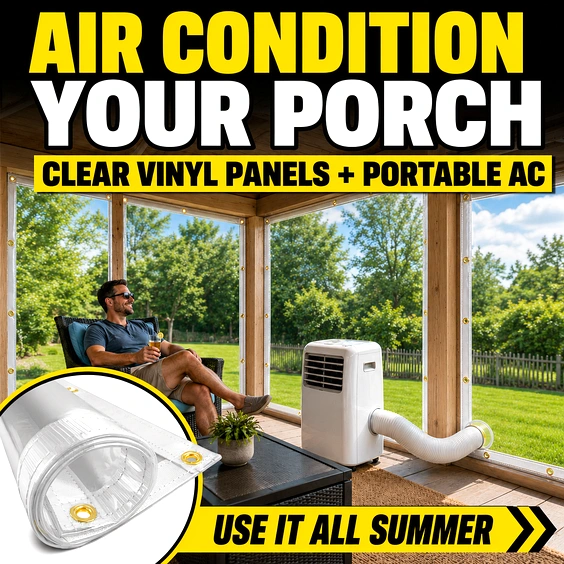
- A portable air conditioner can cool a screened-in porch, but only if you reduce how much cooled air escapes through the screens. A vinyl patio and porch enclosure is one simple way to close those gaps.
- Screens are built for airflow, so they let cool air out and hot air in. Clear custom tarp panels cover the openings while keeping your view and natural light.
- Panels are custom-fit, removable, and seasonal. Use them with a portable AC in summer, then take them down or pair them with a heater in cooler months.
- Clear panels cost less than glass windows or a full sunroom, and they cool better than fans alone.
Updated: June 2026
Clear Panels Used With Portable AC Units
Don't Let The Heat Shut Down Your Screened Enclosure
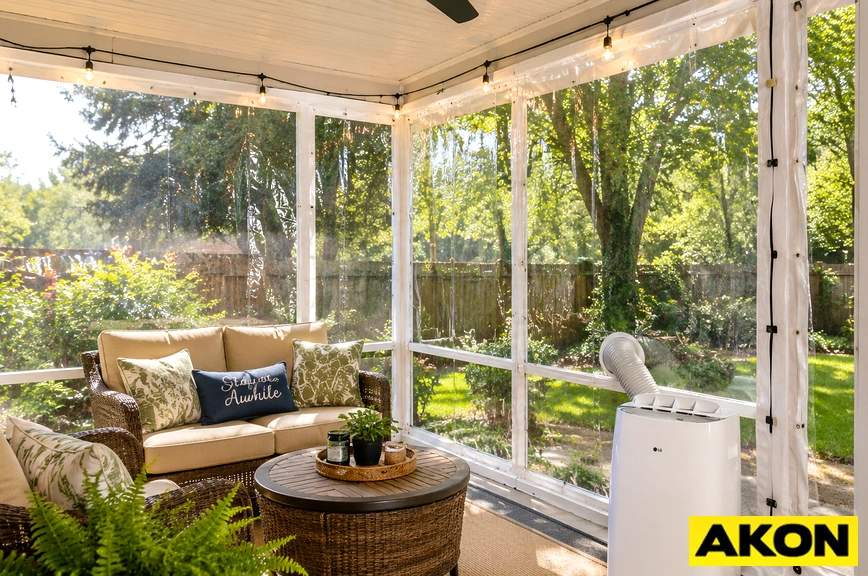
A screened-in porch is a great place to relax, until summer heat makes it too hot to enjoy. By mid-afternoon, many porches feel warmer than the yard, and the screened porch sits empty during the hottest part of the day.
Most people reach for a fan or a portable air conditioner first. There is one catch: screens are built to let air pass through, so they let cooled air right back out. Before any AC can keep up, the porch needs a better barrier between the cool inside and the hot outside. A simple vinyl patio and porch enclosure is one way to close that gap.
Can You Air Condition a Screened-In Porch?
Yes, you can air condition a screened porch, but only if the space is closed off enough to hold cooled air. An open screen lets most of the cold air escape before it can lower the temperature.
A screened porch is built for airflow. That is perfect for a breezy evening, but it works against you when you want to cool the space. The same screens that let in fresh air also let cooled air leave.
To cool a screened porch, you need to slow that air exchange. Once the openings are covered, a portable AC has a real chance to drop the temperature and hold it there.
What Is the Simplest Way to Enclose a Screened Porch for Summer?
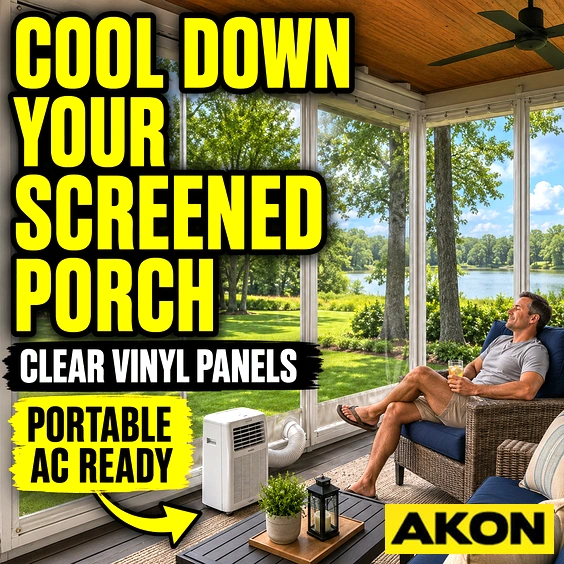
The simplest fix is to cover the screened openings with clear custom tarp panels. They create a temporary enclosure that holds cooled air while keeping your view and natural light.
Clear custom tarp panels are made to fit each screened opening on your porch. They attach over the screens and close off the gaps that let cooled air escape. You are not rebuilding the porch. You are giving it a seasonal barrier so a portable AC can do its job.
The goal is not to turn the porch into a permanent room. It is to make the porch usable on hot days. A temporary porch enclosure can go up for summer and come down when the weather cools, or stay up year-round if you prefer.
The same panels help in cooler months too. In winter, they hold warmer air inside when you run a heater. Summer cooling is the main job here, but the seasonal flexibility is a nice bonus.

Why Clear Custom Tarp Panels Work Well for This
- They are custom made to fit each screened opening, so the seal is tight.
- The clear material keeps your outdoor view and lets in natural light.
- They help reduce cool-air loss, so a portable AC works better.
- They can be removable or left up for the whole season.
- They cost less and install easier than glass windows or a full sunroom.
Is This the Same as a Sunroom? No.
Clear panels make a porch feel more enclosed, but they are not a fully built sunroom. There is no framing, glass, or permanent construction. The value is flexibility: you get better comfort and a clear view without a major remodel.
Using The Portable Air Conditioner

How Do You Get the Best Cooling From a Portable AC on an Enclosed Porch?
Pick the right size unit, vent the exhaust hose outside, close the panels before you start, and run a fan to move the cool air. Small steps add up to a noticeably cooler porch.
A few simple habits make a big difference once your screened openings are covered:
- Use a portable AC sized for your porch area. A unit that is too small cannot keep up.
- Vent the exhaust hose outside so hot air leaves the space.
- Keep the exhaust hose short and as straight as you can for better airflow.
- Seal around the hose opening so hot air does not sneak back in.
- Run a fan to spread cooled air across the porch.
- Close the clear panels before you turn on the AC.
- Use shade or outdoor shades to block direct sun where possible.
Cooling results depend on porch size, sun exposure, how well the panels seal, humidity, the AC size, and how the exhaust vents. Clear panels will not make a porch as cold as an indoor room, but they help a portable AC hold a comfortable temperature on hot days. For sizing help, ENERGY STAR publishes cooling capacity guidance by room size. You can view Portable Air Conditioner Reviews on YouTube and use our useful portable AC widget below to help you choose the right model.
What Size Portable Air Conditioner Do You Need?
Choose the approximate size of your enclosed porch, then check any conditions that apply. This guide focuses on cooling capacity and practical features, not brands.
1. Select your enclosed porch size
Use the total floor area after the porch is enclosed. For a rectangular porch, multiply length by width.
2. Check any porch conditions that apply
These conditions can increase the cooling load. When several apply, choose the next larger cooling range or consider two smaller units.
3. Recommended cooling capacity
Small enclosed porch
For a portable AC, look for a compact unit with a DOE/SACC rating close to this range. If the porch is sunny or humid, step up to the next size range.
Small to medium enclosed porch
This is a common size for smaller enclosed porch areas. Choose a unit with good moisture removal and a practical exhaust hose setup.
Medium enclosed porch
This range works for many medium porch spaces. If there is strong sun exposure, consider moving up to an 8,000 BTU range.
Medium enclosed porch
A good middle-range choice for enclosed porch areas. For better performance, choose a model with strong airflow and a short, well-sealed exhaust route.
Large enclosed sitting area
This size is useful when the porch is large enough for multiple seating zones. If the layout is long or narrow, airflow direction becomes especially important.
Large enclosed porch
At this size, choose a stronger portable AC and pay close attention to the DOE/SACC rating. Dual-hose designs are preferred when available.
Large porch or sunroom-style area
This range is better for larger enclosed spaces. Prioritize DOE/SACC capacity, dual-hose operation, strong airflow, and a continuous drain option.
Very large enclosed porch
This is the upper range of many consumer portable AC units. For a hot, sunny, or humid porch, consider two smaller units placed apart instead of relying on one unit.
Extra-large enclosed area
This is beyond what many single portable AC units can handle well. Consider two portable AC units, a larger dedicated cooling solution, or a professional HVAC recommendation.
Features to Look For in a Portable AC for an Enclosed Porch
- DOE/SACC BTU rating: Use this rating when comparing portable AC cooling power.
- Dual-hose design: Usually better for larger enclosed porch areas.
- Dehumidifier mode: Important for humid summer comfort.
- Continuous drain option: Helpful if the unit will run for long periods.
- Short exhaust path: Keep the exhaust hose as short and straight as practical.
- Directional airflow: Helps move cool air across a porch instead of cooling only one corner.
- Electrical fit: Check the amp draw and outlet requirements before buying.
This guide is for general product selection. Actual comfort can vary based on sun exposure, ceiling height, humidity, insulation, exhaust hose setup, and how tightly the porch is enclosed.
Choosing the Right Way to Cool Your Screened Porch
Clear Panels vs. Other Screened Porch Cooling Options
| Option | Pros | Cons |
|---|---|---|
| Ceiling fans | Low cost and easy to add | Moves air, but does not lower the air temperature |
| Outdoor shades | Blocks sun and glare | Does not seal the porch or hold cooled air |
| Portable AC alone | Easy to buy and move | Struggles when the screened porch is still open |
| Mini-split | Strong cooling power | Higher cost and more permanent installation |
| Glass windows | Strong enclosure | Expensive and changes the porch more permanently |
| Clear custom tarp panels | Seasonal, clear, custom fit, and removable | Best for temporary or seasonal enclosure, not a full sunroom |
A Seasonal Way to Make Your Screened Porch Comfortable

Why Does a Portable AC Struggle on an Open Screened Porch?
A portable AC struggles on an open porch because cooled air escapes through the screens almost as fast as the unit makes it, while hot outdoor air keeps flowing in to replace it.
Screens have thousands of tiny holes. Cool air slips through every one of them. Warm, humid outdoor air moves in to take its place. The AC ends up trying to cool the whole outdoors, not just your porch.
This forces the unit to run nonstop. It uses more power, wears out faster, and still cannot hold a comfortable temperature on a hot day.
Portable AC Units Still Need to Vent
Most portable air conditioners push hot air outside through an exhaust hose. If that hot air is not vented out, it comes right back into the space you are trying to cool. The U.S. Department of Energy notes that correct sizing and setup matter a lot for how well a room air conditioner performs.
Better sealing means better cooling. The more you reduce airflow through the screens, the less the AC has to fight. That is where clear panels come in.
"Our back porch faces west and used to hit the mid-90s every afternoon, so we basically stopped using it in July. We had AKON make clear panels for the four screened openings and paired them with a portable AC. The porch now stays around the mid-70s on hot days, and we have added almost three months of use to our season. Taking the panels down in the fall took about ten minutes."
- Karen Delgado, Homeowner, Charleston, SC
Easy DIY Installation

"Before you order clear panels for a porch, measure each screened opening, note the frame material, and take a few photos. Decide whether you want the panels to be removable or stay up for the season, and plan where the portable AC and its exhaust hose will sit. Tell us if you want to see through every panel or just some of them. Sending measurements and photos is the fastest way for us to recommend the right fit."
- Kevin Calatin, Operations Manager, AKON Curtains
Frequently Asked Questions About Cooling a Screened Porch With Portable AC
Can you use a portable air conditioner on a screened-in porch?
How do I keep cool air inside a screened porch?
Do I need to vent a portable AC on a porch?
What is the easiest way to enclose a screened porch for summer?
Are clear porch panels only for winter?
Will clear tarp panels make my porch feel like a sunroom?
Can I still see outside through clear porch panels?
Is it cheaper to use clear panels than to convert a porch into a sunroom?
Screened Porch Cooling at a Glance

Clear Panel and Portable AC Quick Guide
Screened Porch Cooling at a Glance
- A portable AC in the 8,000 to 14,000 BTU range suits most small to medium screened porches.
- Clear panels can preserve nearly full visibility, so you keep your outdoor view.
- Custom-fit panels cover each opening exactly, which tightens the seal.
- Panels come down in about 10 to 15 minutes for seasonal storage.
- Two seasons of use, cooling in summer and warmth retention with a heater in cooler months.
- Clear panels cost far less than a sunroom conversion or a glass window install.
Cool Your Screened Porch With Portable AC and Clear Panels
Less Air Loss
Closing the screens helps hold cooled air inside, so a portable AC does not have to run nonstop.
Custom Fit
Each panel is made to fit your exact screened openings, so the seal is tight and clean.
Cooler Porch
A portable AC can lower the temperature once the screened openings are closed off and the cool air stays inside.
Clear View
Clear panels keep your outdoor view and let in natural light while blocking airflow through the screens.
Seasonal Use
Panels are removable, so you can put them up for summer and take them down when the weather cools.
Conclusion
A screened porch does not have to sit empty all summer. The problem is not the porch or the air conditioner. It is the open screens that let cooled air escape and hot air pour back in. Close those openings, and a portable air conditioner can finally keep up.
Clear custom tarp panels give you a seasonal enclosure that holds cooled air while keeping your view and your light. They are custom-fit, removable, and far cheaper than glass or a full sunroom. Put them up for summer cooling, keep them for winter warmth with a heater, or take them down whenever you want the open-air porch back.
Get Started Now
Contains: BlogPosting + Person + FAQPage + Organization JSON-LD.
Visible in editor only. Do not duplicate or edit manually.
About the Author
Scott Fullerton is the Operations Manager at AKON Curtains. With over 15 years of experience in industrial curtain and cover solutions, Scott oversees product development, technical specifications, and digital operations across US, UK, and European markets. He ensures customers get accurate, practical guidance on selecting the right products for their facilities. Connect with Scott on LinkedIn.