

Key Takeaways
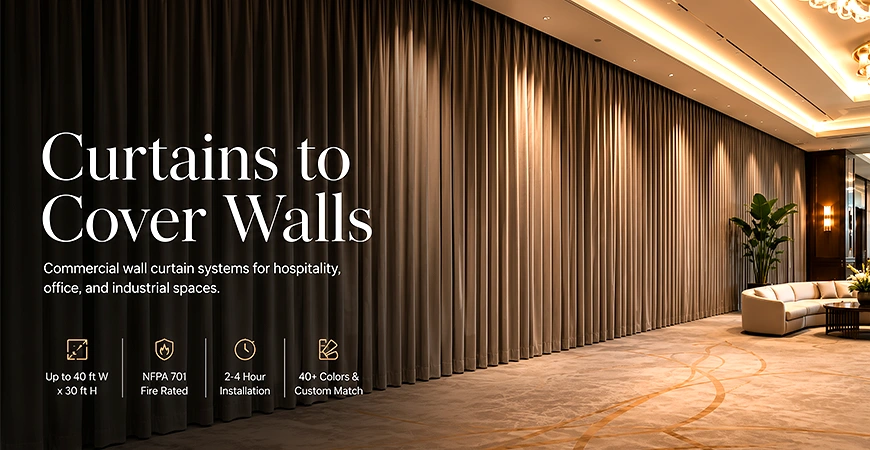
Commercial curtains to cover walls give facility managers a fast, modular way to hide cinder block, exposed pipes, storage areas, and industrial infrastructure without building permanent drywall. The right material depends on the environment. Vinyl curtains work best in warehouses, auto shops, and loading docks where surfaces get dirty and need regular wipe-downs. Fabric curtains are the better choice for hotels, showrooms, corporate offices, and event venues where a polished, professional finish matters. Both options are available with NFPA 701 fire ratings, heavy-duty ceiling track systems, and custom sizing for walls up to 40 ft wide and 30 ft tall. See our full range of commercial fabric curtains for specifications and ordering.
Updated: May 2026


How Do Commercial Curtains to Cover Walls Compare to Permanent Drywall?
Curtains to cover walls cost 40% to 60% less than drywall, install in hours instead of days, and give you full access to the infrastructure behind them whenever you need it.
Facility managers dealing with exposed cinder block, visible pipe runs, electrical conduit, or overflow storage areas face a common decision: build a permanent wall or hang a curtain. For most commercial applications, the curtain wins on cost, speed, and flexibility. A full drywall project on a 30 ft x 16 ft wall runs $3,500 to $6,000 including framing, finishing, and paint, plus 3 to 5 days of disruption. A custom commercial curtain covering the same area costs $1,200 to $2,800 and installs in a single morning.
The Access Problem with Drywall
The pipes and wiring you are hiding behind drywall still need maintenance. A burst pipe behind a finished wall means cutting through drywall, fixing the pipe, then patching, taping, and repainting the wall. With curtains, you slide the panel aside, fix the pipe, and slide it back. Total downtime: minutes instead of days.
This is particularly relevant for older facilities where pipe runs, electrical panels, and HVAC ducts were never designed to be concealed. Building inspectors in many jurisdictions also require access panels for fire suppression lines and electrical junctions. Curtains solve the access problem without any code complications.
Reconfiguration Without Demolition
Retail showrooms, event venues, and warehouse operations change their layouts regularly. Drywall is permanent. Tearing it out and rebuilding costs nearly as much as the original installation. Curtains on ceiling-mounted track systems can be reconfigured in an afternoon. You can relocate panels to different walls, extend coverage by adding panels to the existing track, or remove them entirely and reinstall in a different building.
The Hospitality Solution: Fabric Curtains to Cover Walls in Professional Settings
Fabric wall curtains deliver the upscale, tailored look that hotels, corporate offices, showrooms, and event venues need, with acoustic benefits that vinyl cannot match.
In professional and client-facing environments, the wall covering is part of the brand experience. Vinyl looks industrial. That is fine for a warehouse, but wrong for a hotel ballroom, a corporate conference center, or a retail showroom. Fabric curtains provide the drape, texture, and visual warmth that these spaces require.
Aesthetic Advantages of Fabric
Fabric curtains hang with a natural drape that softens the look of any room. They are available in dozens of colors, textures, and weights, from sheer voile for a light, airy feel to heavy velour for a rich, sound-absorbing finish. Custom color matching lets you align the curtain with existing decor, brand colors, or architectural finishes.
For extra-large commercial curtain applications covering walls over 20 ft wide or 16 ft tall, we supply single-panel runs with no visible seams. This creates a seamless backdrop that looks like a finished architectural feature rather than a retrofit.
Acoustic Performance
Fabric absorbs sound. In large, hard-surfaced rooms (concrete floors, glass walls, exposed ceiling decks), echo and reverberation make conversation difficult and create an unpleasant atmosphere. A heavy fabric curtain on one or two walls reduces reverberation time by 30% to 50%, depending on the fabric weight and room geometry. Hotels use this technique in ballrooms, conference centers use it in breakout rooms, and corporate offices use it in open-plan areas to reduce noise bleed between departments.
Vinyl reflects sound rather than absorbing it. If acoustic control is part of the project brief, fabric is the only option.


Beyond the Look: Why Commercial-Grade Matters
Retail curtains from home improvement stores fail within months in commercial settings because they lack fire ratings, UV stabilizers, and hardware designed for daily heavy use.
Facility managers sometimes try to save money by purchasing residential-grade curtains and hanging them on consumer-grade rods. This approach fails in three critical ways: fire compliance, durability, and hardware capacity.
NFPA 701 Fire Ratings
Any curtain or drape hung in a commercial, public-assembly, or institutional space must meet NFPA 701 fire propagation standards. This is not optional. Fire marshals inspect for it, insurance underwriters require it, and building codes reference it. Residential curtains are not tested to NFPA 701. Hanging untested curtains in a commercial facility creates a fire liability that can void your insurance coverage and trigger code violations during inspection.
Every curtain we supply is NFPA 701 tested and certified. The test certificate ships with the order so you have documentation ready for your fire marshal or insurance auditor. For broader OSHA fire safety requirements in your facility, the OSHA fire safety overview covers the full scope of workplace obligations.
Hardware That Handles the Weight
A commercial wall curtain covering a 30 ft x 16 ft area weighs 80 to 150 lbs depending on material. Consumer curtain rods are rated for 15 to 25 lbs. They will sag, pull out of the wall anchors, or collapse entirely under commercial curtain weight. Our ceiling-mounted track systems are rated for loads up to 500 lbs per track run, use steel carriers with sealed bearings, and anchor directly into structural steel or concrete with expansion bolts. The curtain glides smoothly on the track even at full weight, and the hardware is designed for tens of thousands of open-close cycles.
Wall Covering Material Comparison
| Specification | Vinyl Wall Curtains | Fabric Wall Curtains | Permanent Drywall |
|---|---|---|---|
| Cost per sq ft (installed) | $2.50 - $5.00 | $3.00 - $7.00 | $7.00 - $12.00 |
| Installation Time (30 ft wall) | 2 - 4 hours | 2 - 4 hours | 3 - 5 days |
| NFPA 701 Fire Rated | Yes (standard) | Yes (standard) | Fire-rated drywall available at premium |
| Access to Infrastructure Behind | Slide open in seconds | Slide open in seconds | Cut and patch required |
| Relocatable | Yes, reuse track and panels | Yes, reuse track and panels | No, demolish and rebuild |
| Maintenance | Wipe with cloth or hose down | Vacuum or dry clean | Repaint every 3 - 5 years |
| Acoustic Performance | Minimal (reflects sound) | Good (absorbs 30 - 50% reverberation) | Moderate (depends on insulation) |
| Best For | Warehouses, auto shops, loading docks | Hotels, showrooms, corporate offices | Permanent partitions with no access needs |
Why Choose Commercial Curtains to Cover Walls


The Industrial Solution: Vinyl Curtains to Cover Walls in High-Traffic Settings
Vinyl wall curtains are the right choice for any facility where the wall covering will get dirty, bumped by equipment, or exposed to moisture, chemicals, and temperature swings.
Warehouses, auto shops, loading docks, manufacturing floors, and maintenance bays are "dirty" environments. The wall covering in these spaces needs to survive forklift traffic, grease, cleaning chemicals, and constant handling. Fabric would stain, absorb odors, and require frequent replacement. Vinyl handles all of it.
Why Vinyl Works in Industrial Settings
Our 18 oz PVC vinyl is the same material used in industrial curtain walls and welding screens. It is completely wipeable with standard cleaning solutions, resistant to oils and solvents, and does not absorb moisture or odors. A warehouse manager can spray down a vinyl wall curtain with a hose at the end of a shift and it dries in minutes.
Vinyl also holds up to incidental contact from pallet jacks, hand trucks, and forklifts. The 18 oz weight provides enough tear resistance that a glancing blow from equipment does not puncture the material. For heavier-duty applications, we offer 22 oz vinyl with reinforced grommets at stress points.
Common Industrial Applications
The most common use we see is hiding cinder block walls in customer-facing areas of otherwise industrial buildings. A distribution center with a client visit area, an auto dealership service bay visible from the showroom, or a food processing facility with a viewing corridor. The vinyl curtain creates a clean, uniform surface that looks professional without the cost or permanence of drywall.
Other applications include concealing overflow storage, screening off dock doors during tours, and creating temporary partitions that double as wall coverings when not in use as room dividers.
Which Facility Types Use Curtains to Cover Walls?
Any commercial space with exposed infrastructure, unfinished walls, or a need to transform its appearance quickly and affordably is a candidate for wall curtains.
Warehouses and Distribution Centers
The primary use is screening off cinder block, dock doors, pipe runs, and overflow storage in areas where clients, auditors, or visitors walk through. A set of vinyl wall curtains covering 3 to 4 walls at 2,000 to 3,000 sq ft total typically costs $4,000 to $8,000 installed, compared to $15,000 to $25,000 for equivalent drywall.
Hotels and Event Venues
Ballrooms, conference halls, and banquet rooms use fabric wall curtains as both a permanent design feature and a reconfigurable event backdrop. A single venue may own 3 to 4 sets of curtains in different colors and swap them depending on the event. This is vastly cheaper than repainting or re-finishing walls for each booking.
Auto Dealerships and Service Centers
The service bay is visible from the showroom in many dealership layouts. Vinyl wall curtains between the two areas create a clean visual barrier that blocks sight lines to lifts, tool storage, and work-in-progress vehicles. The curtains slide open after hours for full access between the spaces.
Retail and Corporate Showrooms
Fabric curtains are used as backdrops behind product displays, reception desks, and presentation areas. They create a consistent, branded background that photographs well and hides whatever is behind the wall (storage, mechanical rooms, unfinished space). Corporate offices in converted industrial buildings use them to soften exposed concrete and brick without permanently altering the structure.


Frequently Asked Questions About Curtains to Cover Walls
What is the best curtain material to cover warehouse walls?
Do commercial wall curtains need to be fire rated?
How much do curtains to cover walls cost compared to drywall?
Can fabric curtains reduce echo in large commercial spaces?
How are wall curtains mounted in commercial buildings?
Can curtains be used to hide pipes and wiring on commercial walls?
What is the largest wall size that a single curtain panel can cover?
Commercial Wall Curtain Specifications at a Glance

How Vinyl, Fabric, and Drywall Compare
Commercial Wall Curtain Specifications at a Glance
- 18 oz and 22 oz PVC vinyl options for industrial and high-traffic environments
- Fabric weights from 8 oz voile to 24 oz velour for professional and hospitality settings
- All materials available with NFPA 701 fire propagation certification
- Ceiling-mounted steel track rated for loads up to 500 lbs per run
- Single-panel runs covering walls up to 40 ft wide and 30 ft tall with no visible seams
- Installation time: 2 to 4 hours per wall with no demolition, framing, or finishing required
- Available in 40+ standard colors plus custom color matching for brand alignment
The Commercial Guide to Curtains to Cover Walls
Fully Modular
Curtains slide open for full access to pipes, wiring, and storage behind the wall. Relocate panels to a different wall or building when your layout changes.
Installs in Hours
Ceiling-mounted track and curtain panels go up in 2 to 4 hours per wall, compared to days of demolition, framing, and finishing for drywall.
NFPA 701 Rated
Both vinyl and fabric curtains are available with NFPA 701 fire ratings, meeting the standard required by fire marshals for commercial and public-facing spaces.
Custom Sized
Every curtain is cut to your wall dimensions, covering spans up to 40 ft wide and 30 ft tall with no seams, gaps, or visible hardware on the face.
Two Material Paths
Vinyl for high-traffic, dirty environments that need wipe-clean durability. Fabric for professional, client-facing spaces that need an upscale finish.
Conclusion
Vinyl curtains handle the warehouses, loading docks, and auto shops where surfaces get dirty and need hosing down. Fabric curtains handle the hotels, showrooms, and corporate offices where the wall covering is part of the brand experience. Both install in hours on the same ceiling-mounted track system, both meet NFPA 701 fire ratings, and both cost 40% to 60% less than equivalent drywall with none of the access problems that come with permanent construction.
The deciding factor is your environment. If the curtain will get splashed, bumped, or sprayed down, choose 18 oz vinyl and save yourself the maintenance headaches that fabric would create in that setting. If your space needs to impress clients and absorb sound, fabric is the only material that delivers both. Either way, you get a wall covering that installs in a morning, slides open for full infrastructure access, and relocates to a different wall or building when your layout changes.
Need Curtains to Cover Walls in Your Facility?
We design, supply, and install custom wall curtains in vinyl and fabric for warehouses, hotels, showrooms, and commercial facilities across the United States. Call us for a free consultation and quote.
Get Your QuoteContains: BlogPosting + FAQPage + Organization JSON-LD.
Visible in editor only. Do not duplicate or edit manually.
About the Author
Scott Fullerton is the Operations Manager at AKON Curtains. With over 15 years of experience in industrial curtain and cover solutions, Scott oversees product development, technical specifications, and digital operations across US, UK, and European markets. He ensures customers get accurate, practical guidance on selecting the right products for their facilities. Connect with Scott on LinkedIn.