

Key Takeaways
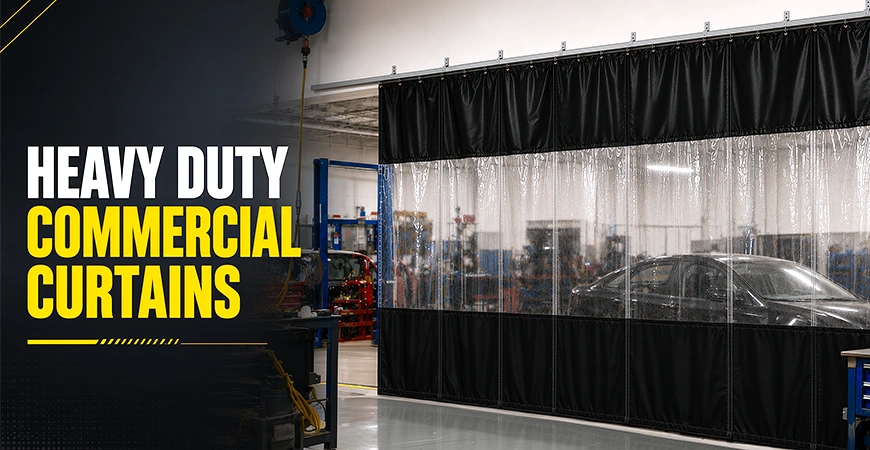
Heavy duty commercial curtains are built from 18 oz to 40 oz industrial-grade vinyl and canvas, with electronically welded seams, steel-track mounting hardware, and NFPA 701 fire certification. They handle daily abuse from forklifts, temperature swings from -40 F to 160 F, and chemical exposure that would destroy a residential curtain in weeks. If your facility runs equipment, moves product on wheels, or deals with welding sparks, dust, and coolant spray, the fabric weight and hardware grade determine whether the curtain lasts 8 months or 8 years. See our full range of commercial fabric curtains for specifications and ordering.
Updated: May 2026

What Makes a Commercial Curtain "Heavy Duty"?
A heavy duty commercial curtain starts at 18 oz per square yard vinyl with electronically welded seams, brass grommets, and steel-track mounting hardware rated for hundreds of pounds.
The term "heavy duty" gets used loosely in online product listings. Residential curtain retailers apply it to anything over 10 oz. In commercial and industrial applications, the threshold is higher and the specifications are measurable. A curtain qualifies as heavy duty when the fabric weight, seam construction, mounting hardware, and fire certification are all rated for the environment where it will hang.
Fabric weight is the starting point. Industrial vinyl curtains use PVC-coated polyester measured in ounces per square yard. An 18 oz vinyl is the baseline for commercial applications: warehouse dividers, dock door screens, and general-purpose partitions. It handles moderate forklift traffic, regular cleaning, and temperature ranges from -40 F to 160 F. For heavier abuse, 22 oz and 40 oz options provide progressively more tear resistance, puncture strength, and longevity in environments with welding sparks, chemical exposure, or constant equipment contact.
The commercial fabric curtain category also includes heavy canvas and polyester options for applications where vinyl is not the right fit. Canvas curtains at 16 oz to 24 oz serve paint booths, sandblasting enclosures, and dust containment areas where the fabric needs to breathe rather than seal.
Seam Construction: Where Cheap Curtains Fail First
Electronically welded seams resist 3x the tearing force of standard stitching and eliminate the needle holes that become the first point of failure under load.
Seam failure is the number one reason commercial curtains get replaced early. A curtain can have the right fabric weight and the right fire rating, but if the seams are sewn with lightweight thread through punched holes, the curtain will tear at the seam long before the fabric itself wears out.
RF Welded vs Stitched Seams
Industrial-grade curtains use radio frequency (RF) bar welding to join panels and create hems. The process fuses the PVC coating at the molecular level, creating a bond that is actually stronger than the surrounding fabric. There are no needle holes, no thread to degrade from UV or chemical exposure, and no weak points where water or dust can penetrate.
Stitched seams use nylon or polyester thread pulled through needle holes in the fabric. The thread itself is strong, but the holes create stress concentration points. Under wind load, equipment impact, or the cumulative weight of the curtain pulling on its own grommets, the fabric tears at the needle holes. In our experience, stitched-seam curtains in high-traffic industrial settings start showing seam failure within 12 to 18 months. RF welded seams on the same fabric in the same environment last the full life of the material.
Double-Lock Stitching for Non-Weldable Fabrics
Canvas and certain specialty fabrics cannot be RF welded because they lack the PVC coating needed for the fusion process. For these materials, double-lock stitched seams with heavy-duty nylon thread are the correct specification. The double-lock stitch creates interlocking loops that distribute load across a wider area, reducing the stress on individual needle holes. It is not as strong as RF welding, but it is the best available option for non-vinyl fabrics.


Hardware That Matches the Fabric: Track, Carriers, and Mounting
A 22 oz vinyl curtain covering a 30 ft x 16 ft area weighs over 120 lbs. Consumer-grade curtain rods collapse under that load in days. Steel track systems handle it for decades.
The hardware is half the installation. You can specify the heaviest vinyl on the market, and if it hangs from undersized hardware, the system will fail. OSHA workplace safety requirements extend to overhead mounted equipment in occupied facilities, which means the track system needs to be rated for the actual load it carries, with an appropriate safety factor.
Ceiling-Mounted Steel Track
Heavy duty curtain track is extruded steel or aluminum, mounted directly to structural members (steel beams, concrete ceilings, or engineered wood trusses) with expansion bolts or through-bolts. Our standard track is rated for 500 lbs per run, which accommodates even the heaviest 40 oz vinyl curtains on spans up to 40 ft. The track profile allows smooth carrier travel with minimal friction, so a curtain that weighs 150 lbs can still be opened and closed by one person.
Sealed-Bearing Carriers
Each curtain panel hangs from steel carriers with sealed ball bearings that roll inside the track channel. Sealed bearings keep out dust, welding particulate, and moisture. Open-bearing carriers (common on cheaper systems) clog with debris within months in a manufacturing environment, making the curtain difficult or impossible to move. Our carriers are rated for tens of thousands of open-close cycles before the bearings need service.
Grommets and Attachment Points
Heavy duty curtains use rustproof brass grommets at every carrier attachment point. The grommet reinforces the fabric around the hole, distributing the hanging load across a wider area. For commercial divider curtains in high-wind or high-traffic areas, we add reinforced hem strips at the grommet line to prevent tear-out under dynamic loading.
Industrial Curtain Fabric Comparison
| Specification | 13 oz Vinyl | 18 oz Vinyl | 22 oz Vinyl | 40 oz Vinyl |
|---|---|---|---|---|
| Typical Application | Office, retail, events | Warehouse, dock, general industrial | Auto body, heavy mfg, steel fab | Welding, foundry, chemical, outdoor |
| Tear Resistance | Moderate | Good | High (40% over 18 oz) | Maximum |
| Forklift Traffic | ✗ Not rated | ✓ Incidental | ✓ Regular | ✓ Aggressive |
| Temperature Range | 32 F to 120 F | -40 F to 160 F | -40 F to 160 F | -40 F to 180 F |
| Chemical Resistance | Basic (water, mild soap) | Good (oils, solvents) | High (acids, caustics) | Maximum (industrial chemicals) |
| Expected Service Life | 3 - 5 years | 5 - 8 years | 7 - 10+ years | 10 - 15+ years |
| NFPA 701 Fire Rated | ✓ | ✓ | ✓ | ✓ |
Why Fabric Weight and Hardware Grade Matter


Why Fabric Weight Determines How Long Your Curtain Lasts
Every additional ounce of fabric weight adds measurable tear strength, UV resistance, and abrasion tolerance. The wrong weight for your application cuts the curtain's service life in half.
13 oz Vinyl: Light Commercial
The lightest vinyl we offer for commercial use. Suitable for indoor partitions in climate-controlled spaces with no equipment traffic. Office dividers, retail storage screens, and event backdrops. Expected service life of 3 to 5 years in a clean, low-traffic environment. This weight is not appropriate for warehouses, manufacturing, or any space where the curtain will take physical contact from carts, pallets, or personnel.
18 oz Vinyl: Standard Industrial
The workhorse of commercial curtain applications. In our experience, 18 oz vinyl covers about 70% of industrial curtain orders because it balances durability with cost. It handles forklift-adjacent installations, dock door screening, warehouse partitions, and temperature isolation. Tear strength is sufficient for incidental contact from equipment and personnel. Expected service life of 5 to 8 years in a typical warehouse or manufacturing environment with regular cleaning.
22 oz Vinyl: High-Abuse Environments
Specified for facilities where the curtain takes regular physical contact. Auto body shops, heavy manufacturing lines, steel fabrication, and loading docks with aggressive forklift traffic. The additional weight provides 40% more tear resistance than 18 oz and better puncture performance at stress points like grommets and track attachments. Expected service life of 7 to 10+ years depending on the severity of the environment.
40 oz Vinyl: Maximum Protection
The heaviest option for the most punishing applications. Welding curtain walls, foundry partitions, chemical processing barriers, and outdoor enclosures in extreme weather. This weight is overkill for standard warehouse use, but for environments where nothing else survives, 40 oz vinyl delivers the longest possible service life and the highest resistance to sparks, chemicals, and sustained UV exposure.
Frequently Asked Questions About Heavy Duty Commercial Curtains
What weight vinyl is best for warehouse curtains?
How long do heavy duty commercial curtains last?
What is the difference between welded and stitched curtain seams?
Do heavy duty curtains need to be fire rated?
How much weight can a heavy duty curtain track support?
Can heavy duty curtains withstand freezer and cold storage temperatures?
Heavy Duty Curtain Specifications at a Glance

Vinyl Weight Comparison by Application
Heavy Duty Curtain Specifications at a Glance
- 13 oz, 18 oz, 22 oz, and 40 oz PVC-coated polyester vinyl options by weight per square yard
- Seam construction: RF electronically welded for vinyl, double-lock stitched for canvas
- Track load rating: 500 lbs per run on ceiling-mounted extruded steel
- Temperature range: -40 F to 160 F operational flexibility
- Carrier type: sealed ball-bearing steel carriers rated for 50,000+ cycles
- Fire certification: NFPA 701 standard on all commercial vinyl and fabric curtains
- Custom sizing up to 40 ft wide and 30 ft tall per panel with no visible seams
The Specification Guide to Heavy Duty Commercial Curtains
Steel Track Hardware
Ceiling-mounted steel track rated for 500 lbs per run with sealed-bearing carriers. Designed for tens of thousands of open-close cycles under full curtain weight.
NFPA 701 Rated
Every heavy duty curtain ships with NFPA 701 fire test certification, meeting the standard required for all commercial and industrial occupancies.
18 oz to 40 oz Vinyl
Industrial-grade PVC-coated polyester ranging from 18 oz standard duty to 40 oz for the most punishing environments. Weight is measured per square yard.
Welded Seams
Interior seams are electronically welded with RF bar sealers for tear resistance that outperforms standard stitching by 3x under load.
-40 F to 160 F
Industrial vinyl maintains flexibility and tear resistance across extreme temperatures, from freezer storage to foundry-adjacent installations.
Conclusion
The fabric weight sets the floor for everything else. An 18 oz vinyl curtain with welded seams and steel track hardware will outperform a 22 oz curtain with stitched seams and consumer-grade rods. But given equal hardware, the heavier fabric always wins on service life. Match the weight to the abuse: 18 oz for standard warehouse and dock operations, 22 oz for auto body, steel fabrication, and heavy equipment areas, and 40 oz for welding, foundry, and chemical environments where nothing else survives.
The seam construction and hardware grade determine whether the installation lasts. RF welded seams eliminate the needle-hole weak points that cause 80% of early curtain failures in industrial settings, and steel track with sealed-bearing carriers keeps the system operating smoothly through tens of thousands of open-close cycles. Specify the right combination of fabric weight, seam type, and hardware from the start, and the curtain pays for itself by lasting years longer than a lighter, cheaper alternative.
Need Heavy Duty Curtains for Your Facility?
We supply and install heavy duty commercial curtains in 13 oz, 18 oz, 22 oz, and 40 oz vinyl for warehouses, manufacturing plants, auto shops, and industrial facilities across the United States. Call us to discuss your application and get a custom quote.
Get Your QuoteContains: BlogPosting + FAQPage + Organization JSON-LD.
Visible in editor only. Do not duplicate or edit manually.
About the Author
Scott Fullerton is the Operations Manager at AKON Curtains. With over 15 years of experience in industrial curtain and cover solutions, Scott oversees product development, technical specifications, and digital operations across US, UK, and European markets. He ensures customers get accurate, practical guidance on selecting the right products for their facilities. Connect with Scott on LinkedIn.