

Key Takeaways
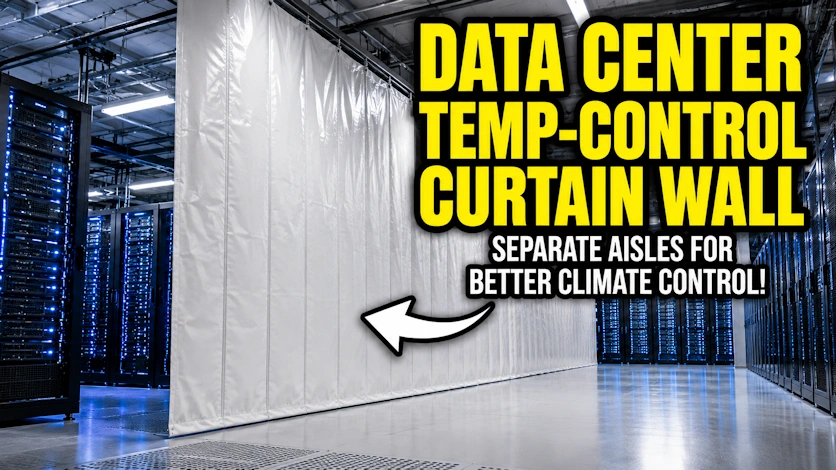
- Data center curtains create flexible barriers that help reduce dust migration, separate hot and cold air, and support static-sensitive work areas without permanent wall construction.
- Insulated curtain walls (R3, R6, or R9 rated) help reduce temperature exchange where cooled IT space borders warmer warehouses, mechanical rooms, or staging areas, supporting your existing cooling infrastructure.
- Anti-static and ESD curtain walls help create separated zones for server repair, component staging, and hardware prep as part of a broader static-control program that includes grounding, humidity control, and proper handling procedures.
- Strip curtains at doorways and aisle ends let people walk through while reducing uncontrolled air exchange and dust movement between adjacent spaces.
Updated: June 2026

Why Curtains Work as Flexible Barriers Inside Data Centers
Curtains give data center teams a way to create, move, and reconfigure physical barriers as facility layouts and cooling demands change, without the cost or permanence of rigid walls.
Data centers depend on controlled airflow, clean equipment areas, and stable temperatures. In practice, many facilities face challenges that disrupt those conditions: foot traffic, open doorways, equipment staging, nearby warehouse space, maintenance work, construction projects, and changing rack layouts. These problems grow as facilities add AI and high-density computing equipment that concentrates heat loads in specific rows.
Curtain walls address these challenges because they install faster than rigid construction in most situations. A commercial curtain wall on a ceiling-mounted track can go up in hours, requires no building permit in most jurisdictions, and creates floor-to-ceiling separation immediately. The same curtain slides open for equipment access and slides closed to restore the barrier.
The key advantage is flexibility. Rack layouts shift, cooling zones expand, and temporary work areas come and go. A permanent wall locks you into one configuration. A curtain system adapts to every change. The ENERGY STAR data center guidance specifically lists plastic curtains as a containment option for separating hot and cold air in data center environments, noting that Google has deployed strip curtains in its own facilities for this purpose.
Control Dust In The Data Center

Using Curtains to Help Reduce Dust Migration in Data Centers
Curtains create a physical barrier between cleaner equipment areas and dirtier adjacent spaces, helping reduce the amount of particulate that reaches sensitive IT hardware. They are very useful for controlling dust during expansion construction.
Common Dust Sources in Data Center Facilities
Dust enters and moves through data center spaces from foot traffic, construction or renovation projects, nearby warehouse areas, loading docks, equipment unpacking, storage zones, and packaging materials. The ASHRAE TC 9.9 datacom guidelines address particulate contamination standards for data center environments, and physical barriers are one layer of protection alongside filtration, cleaning, and contamination monitoring.
Industrial dust control curtains with floor sweeps, valances, and sealed edges are effective at separating active equipment areas from construction zones, unpacking areas, storage rooms, and warehouse loading zones. Clear viewing panels can be added where operators need line-of-sight through the barrier.
Control Temperature In The Data Center

Insulated Curtains for Perimeter and Support Areas
Not every temperature-control problem sits between rows of servers. Many issues occur at the perimeter of the data center, where cooled IT space borders warmer or less controlled areas. A cooled server room next to a warm warehouse. A data hall connected to a loading dock. A mechanical room sharing a wall with an active equipment area.
Insulated curtain walls in R3, R6, or R9 ratings help reduce temperature exchange across these boundaries. They install with floor sweeps, overhead valances, and strip-door entries for walk-through access. Insulated curtains are a practical fit when permanent wall construction is too slow, too expensive, or when the facility still needs regular access between the two areas.
Important: Any containment setup inside a data center should be reviewed to confirm it does not interfere with fire suppression systems, smoke detection, emergency exits, cooling sensors, or required airflow paths.
Strip Curtains for Walk-Through Access Points
Open doorways are weak points for both dust and temperature control. In busy facilities, doors get opened frequently or left open entirely. Each open doorway allows air, dust, and contaminants to move freely between spaces.
PVC strip curtains or anti-static strip curtains solve this problem. Staff walk through and the strips close behind them. The opening stays usable for carts, server racks on wheels, and equipment dollies. Useful locations include server room doorways, aisle-end access points, equipment staging entrances, and warehouse-to-data-center transitions.
Important: Curtains help reduce dust migration, but they do not replace filtration systems, cleaning protocols, contamination monitoring, or proper facility maintenance.


Anti-Static and ESD Curtains for Static-Sensitive Data Center Areas
ESD curtain walls help create separated zones where staff handle electronics, server components, cables, replacement hardware, and other static-sensitive equipment as part of a broader static-control program.
ESD Curtain Options for Data Centers
Data centers often include areas where people handle circuit boards, server trays, network switches, storage drives, and cabling. These areas benefit from static-control materials that help dissipate charge rather than allowing it to build on surfaces. AKON provides several options: ESD curtain walls in solid anti-static vinyl, ESD grid curtains with a conductive carbon grid embedded in clear PVC for visibility, and anti-static strip curtains for walk-through access points in ESD-controlled zones.
Non-outgassing ESD curtains are available for more sensitive environments where off-gassing from standard PVC could be a concern. These work well in areas adjacent to optical equipment, precision instruments, or clean-environment testing stations.
Part of a Broader Static-Control Program
Anti-static curtains are one component of a complete ESD protection strategy. They do not replace grounding, humidity control, ESD flooring, ESD mats, wrist straps, proper handling procedures, or staff training. The curtain material helps prevent charge accumulation on the barrier itself and reduces the transfer of charged particles between zones.
In practice, most data center teams use ESD curtains to physically separate a hardware prep or repair area from the main data hall. The curtain defines the boundary of the ESD-controlled zone and provides a visual reminder for staff entering the area. When paired with grounding and humidity controls, the curtain becomes a practical part of the overall static management plan.
Which Curtain Is Right?
Choosing the Right Curtain for Your Data Center Application
| Primary Concern | Recommended Curtain Type | ESD Safe | Insulated | Walk-Through | Visibility |
|---|---|---|---|---|---|
| Walk-through access | PVC strip curtains or anti-static strip curtains | ✓ (anti-static option) | ✗ | ✓ | ✓ |
| Static control | ESD curtain walls, ESD grid curtains, non-outgassing ESD | ✓ | ✗ | ✓ (with strip entry) | ✓ (grid option) |
| Temperature separation | Insulated curtain walls (R3, R6, R9) with floor sweeps | ✗ | ✓ | ✓ (with strip entry) | ✗ |
| Dust migration | Industrial curtain walls, clean room style, ESD walls | ✓ (ESD option) | ✗ | ✓ (with strip entry) | ✓ (clear panels) |
| Visibility through barrier | Clear PVC, clear ESD material, or ESD grid curtains | ✓ (ESD options) | ✗ | ✓ | ✓ |
| Layout may change later | Track-mounted curtains, sliding curtain walls, freestanding frames | ✓ (ESD material option) | ✓ (insulated option) | ✓ | ✓ (clear option) |
Flexible Environmental Barriers for Modern Data Center Facilities

How Curtains Help Separate Hot and Cold Air in Data Centers
Curtain barriers help keep cold supply air on the intake side of server racks and hot exhaust air on the return side, reducing the mixing that forces cooling systems to work harder.
Strip Curtains and Containment at Aisle Level
Data centers route cold supply air to the front of servers and return hot exhaust air to the cooling system. When hot and cold air mix (at open aisle ends, above racks, or through gaps in containment), rack inlet temperatures climb and cooling equipment runs harder to compensate. Anti-static strip curtains at aisle ends let staff walk through while reducing air mixing between hot and cold aisles.
Clear strip curtains and ESD grid curtains work well in retrofit situations where rigid containment panels are not practical. They mount to existing overhead structures, conform to uneven ceiling lines, and accommodate cable trays or overhead piping that would block rigid panels.
"We had a 12,000 square foot warehouse sharing a wall with our primary server room, and every time the loading dock opened we could see particulate counts spike on our monitoring system. AKON supplied insulated curtain walls with strip-door entries at both access points. Within the first month, our average rack inlet temperature dropped by 4°F and particulate readings in the server room dropped by roughly 35%. The curtains paid for themselves inside of 90 days through reduced cooling costs alone."
— James Whitford, Data Center Operations Manager

"Before ordering curtains for a data center, measure the opening size, note the ceiling height and mounting surface, and photograph the area. Check whether fire suppression heads, smoke detectors, airflow sensors, or cable trays cross the intended curtain path. Decide whether the curtain needs to slide, stay fixed, or be removable. Consider whether you need a strip-door entry, whether visibility through the curtain matters, and whether anti-static, insulated, or standard PVC material is the right fit. Sending us photos and measurements is the fastest way to get an accurate recommendation."
— Scott Fullerton, Operations Manager, AKON Curtains
See How Data Center Curtains Improve Airflow and Climate Control
Frequently Asked Questions About Curtains for Data Centers and Server Rooms
Can curtains be used inside a data center?
Do data center curtains replace HVAC containment systems?
Are strip curtains useful for data center doorways?
When should I use anti-static or ESD curtains in a data center?
Where do insulated curtains make sense in a data center?
Can curtains help with dust control in data centers?
What information does AKON need to recommend a data center curtain?
Common Data Center Curtain Configurations

Choose a layout that fits your needs
- Small server room: Strip curtain doorway plus floor-to-ceiling curtain wall to separate storage, maintenance, or staging areas from active equipment
- Colocation retrofit: Anti-static strip curtains or ESD grid curtains at aisle ends to help reduce air mixing while preserving walk-through access
- Equipment staging area: ESD curtain walls to separate unpacking, testing, and hardware prep from the main data hall
- Warehouse-to-data center transition: Insulated curtain walls with strip-door entries to reduce temperature exchange and dust migration between spaces
- Construction or maintenance zone: Industrial curtain walls with floor sweeps, valances, and sealed edges to reduce dust migration into active equipment areas
- High-density equipment row: Flexible strip curtain containment around a high-load rack zone while the facility evaluates longer-term cooling changes
Data Center Curtains: Dust Control, Climate Zones, and ESD Protection
Walk-Through Access
Strip curtains let staff walk through while the opening closes behind them, reducing uncontrolled air exchange at doorways, aisle ends, and staging entrances.
Anti-Static
ESD curtain walls and anti-static strip curtains help create separated work zones for server repair, hardware prep, and sensitive component handling.
Dust Barrier
Floor-to-ceiling curtain walls with floor sweeps and sealed edges help reduce dust migration from warehouses, loading docks, and construction zones into active server areas.
Climate Zones
Insulated curtains and strip doors help separate cooled IT space from warmer adjacent areas, supporting your cooling system without permanent construction.
Custom Layout
Track-mounted, sliding, and freestanding curtain systems can be moved, adjusted, or reconfigured as rack layouts, cooling demands, and facility needs change over time.
Conclusion
Data center curtains solve a specific category of facility problems: the gaps, open doorways, adjacent spaces, and temporary work zones where controlled conditions break down. An insulated curtain wall between a cooled server room and a warm warehouse helps your cooling system work at the conditions it was designed for. An ESD curtain wall around a hardware prep station creates a defined static-control boundary. A strip curtain at a busy doorway keeps the opening usable while reducing the air and dust exchange that happens every time someone walks through.
The practical value of curtains in data centers is that they adapt to the facility rather than requiring the facility to adapt to them. Track-mounted systems slide open for equipment moves and slide closed to restore the barrier. Insulated panels add thermal separation where it did not exist before. ESD materials support static-control programs without permanent construction. Every curtain is custom-sized to the opening, the ceiling height, and the specific access and environmental requirements of the space.
Choose A Style To Get Started

Solid Data Curtains

Insulated Data Curtains

Strip Data Curtains
Contains: BlogPosting + FAQPage + Organization JSON-LD.
Visible in editor only. Do not duplicate or edit manually.
About the Author
Scott Fullerton is the Operations Manager at AKON Curtains. With over 15 years of experience in industrial curtain and cover solutions, Scott oversees product development, technical specifications, and digital operations across US, UK, and European markets. He ensures customers get accurate, practical guidance on selecting the right products for their facilities. Connect with Scott on LinkedIn.