

Key Takeaways (TL;DR)
- Laser blocking curtains provide certified containment against stray radiation from Class 3B and Class 4 lasers, with triple-layer options rated at 2,150 W/cm² for 100 seconds at 1064 nm.
- Single, double, and triple layer configurations offer scalable protection levels. The material is flame resistant, easy to maintain, and mounts on ceiling or floor track for rapid deployment.
- Facilities operating Nd:YAG, fiber, CO₂, or diode lasers can achieve compliant beam containment through laser barrier curtains at a fraction of the cost of rigid enclosures.
- Add-on ESD and cleanroom layers extend these curtains into electronics manufacturing, medical device assembly, and controlled research environments.
Updated: March 2026
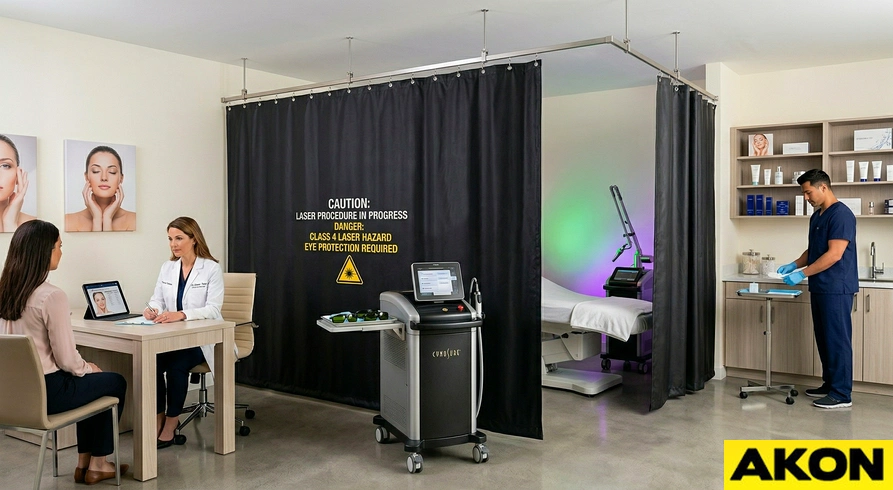
Any facility running a Class 3B or Class 4 laser needs to answer a fundamental question: how do you contain hazardous beam energy without committing to permanent walls that can't adapt when your operations change? We supply laser barrier curtains that address this challenge directly — delivering certified protection at significantly lower cost than rigid enclosures, with installation measured in hours rather than weeks.
Across our work with US manufacturers, research labs, and medical facilities, we've seen a clear trend toward flexible laser containment over the past five years. The driver is simple: laser technology advances faster than fixed infrastructure, and operations need safety solutions that can keep up.
What Makes Laser Blocking Curtains a Safer Choice Than Open Laser Areas?
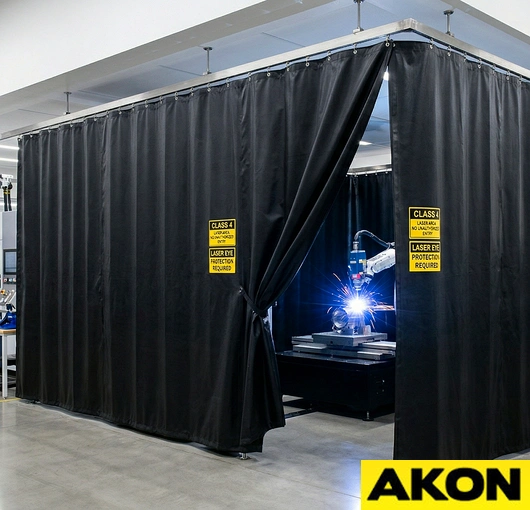
Laser blocking curtains remove the most dangerous variable in laser safety — uncontrolled beam escape from the process zone — by placing a certified, continuous barrier between the laser source and personnel.
An errant beam from a 4 kW fiber laser can inflict permanent retinal damage in under a millisecond. Administrative controls alone — warning signs, restricted access zones, PPE policies — introduce too many points of failure. Our customers consistently report that once a physical curtain barrier goes up, near-miss incidents drop to zero.
The curtain material itself is purpose-built for laser environments: flexible, flame resistant, and easy to clean. It ships in single, double, and triple layer thicknesses matched to your laser's output. A single-layer curtain handles 425 W/cm² for 100 seconds, while a triple-layer system is rated at 2,150 W/cm² for the same duration — both verified at 1064 nm with a 1 mm beam diameter.
These protection levels align with the OSHA-referenced ANSI Z136 standard series, which recognizes curtain barriers as an engineering control for Class 3B and Class 4 laser operations. Every system we supply is specified by qualified Laser Safety Officers to match the exact requirements of your application.
Rigid enclosures deliver comparable containment, but typically cost three to five times more and offer zero reconfigurability. Once a steel or polycarbonate cabin is anchored to the floor, moving your laser cell means tearing it down and rebuilding. A track-mounted curtain system repositions in minutes.
"Our two fiber laser welding stations were enclosed in rigid steel cabins that cost $22,000 each installed. When we expanded to a third station last quarter, we went with double-layer curtain barriers instead — total cost was $7,800 including track hardware, and we had it operational in five hours."
— Jeff Kowalski, Manufacturing Engineering Lead, Hartwell Industrial Solutions LLC
What Protection Levels Are Available for Laser Blocking Curtains?
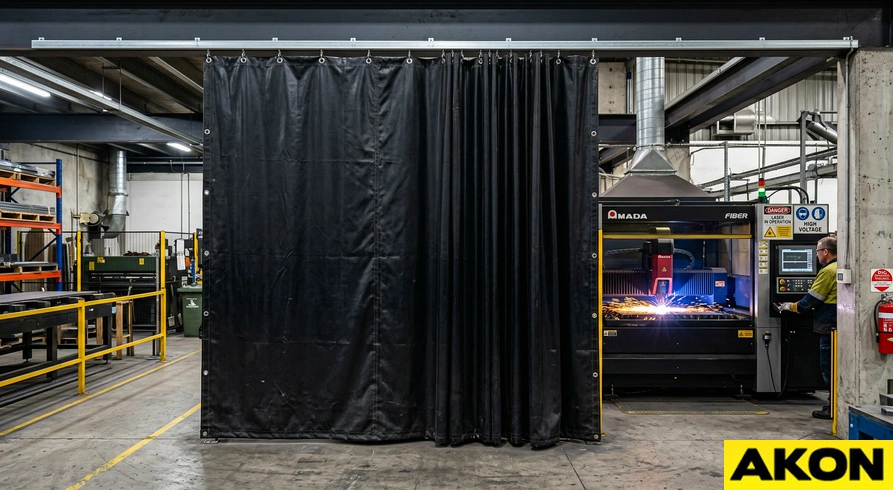
Laser blocking curtains ship in three protection tiers — single, double, and triple layer — rated from 425 W/cm² to 2,150 W/cm² for 100 seconds, verified at 1064 nm with a 1 mm beam diameter.
The single-layer option (425 W/cm²) is designed for lower-power Class 3B applications and scattered-beam containment. The double-layer curtain (575 W/cm²) is the go-to specification for fiber laser welding and handheld laser welding setups, including Lightweld-type systems. The triple-layer curtain (2,150 W/cm²) delivers maximum protection for high-power industrial laser operations.
We always recommend selecting your curtain configuration based on actual power density measurements, not just the laser's class rating. Our team matches the right layer count to your specific laser parameters on every project. For operations that exceed triple-layer ratings, we recommend transitioning to rigid panel barriers.
Laser Blocking Curtains vs Rigid Laser Enclosures: Side-by-Side Comparison
| Factor | Laser Blocking Curtain | Rigid Laser Enclosure |
|---|---|---|
| Typical installed cost (single cell) | $2,500 – $8,000 | $12,000 – $30,000+ |
| Installation time | 4–8 hours ✓ | 1–3 weeks ✗ |
| Reconfigurable / relocatable | ✓ Track-mounted, hook-and-loop joins | ✗ Fixed, requires teardown |
| Max protection (triple layer) | 2,150 W/cm² for 100 sec ✓ | Varies by panel spec ✓ |
| Layer options | Single (425 W/cm²), Double (575), Triple (2,150) | Fixed panel rating |
| ESD / cleanroom layer available | ✓ | ✗ Requires separate treatment |
| Structural modifications needed | ✓ None | ✗ Floor anchors, framework |
| Flame resistant material | ✓ | ✓ |
| Best suited for | Most industrial, medical, and research applications | Applications exceeding curtain ratings or needing physical security |
Safeguarding Your Team with Certified Laser Curtain Barriers
Why Do More Facilities Choose Curtain Systems Over Rigid Laser Enclosures?
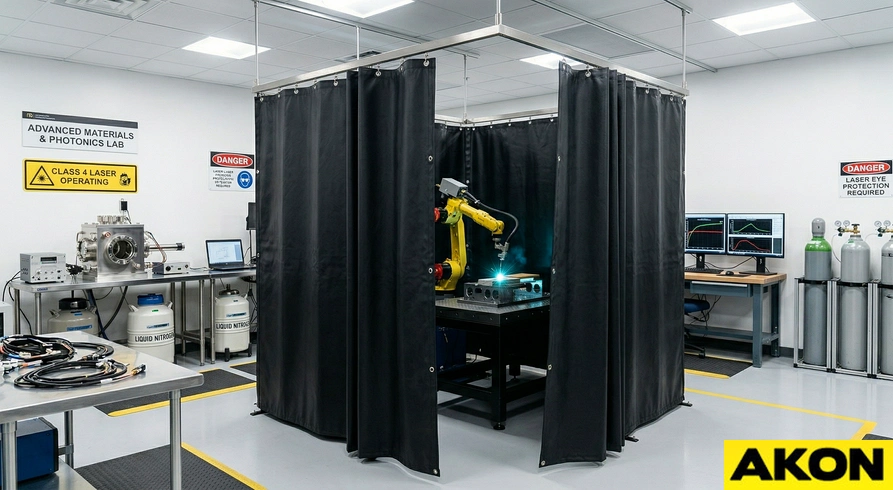
Flexible curtain systems provide equivalent beam containment at approximately 30% of the installed cost of rigid enclosures, with same-day setup and the ability to reconfigure as production needs evolve.
Rigid laser enclosures — steel panel assemblies, interlocked polycarbonate cabins, or custom aluminum framing — remain the correct choice for permanently fixed, high-power automated cells where physical security is a co-requirement. For virtually every other application, laser barrier curtains on overhead track deliver a better combination of safety, speed, and value.
The practical advantages go well beyond purchase price. Curtain systems need no specialized installation crew, no anchor bolts, and no structural modifications to your building. Standard-size panels connect with integrated hook-and-loop fasteners to form larger barriers, and can be detached and rearranged whenever your layout changes.
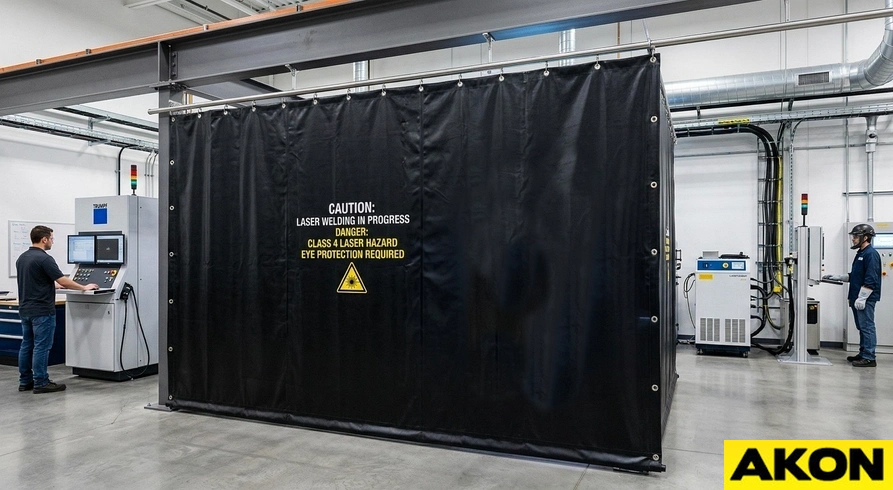
Streamlined Compliance and Documentation
Curtain barriers simplify your compliance obligations by shipping with documented, auditable protection ratings that satisfy your Laser Safety Officer and external auditors alike.
Materials certified to IEC 60825-4 (Safety of Laser Products – Part 4: Laser Guards) carry CE marking with documented protection times at tested power densities. All curtain systems we supply are designed by qualified Laser Safety Officers (LSOs) to address the specific hazards of your operation.
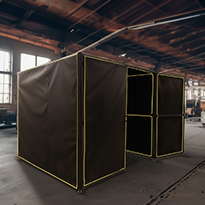
Custom configurations mount to ceilings or floors on track systems that support curved, straight, and combination layouts. Whether you need a room divider, doorway partition, workstation surround, or a full laser welding cell enclosure, the system is engineered to your exact dimensions and access requirements.
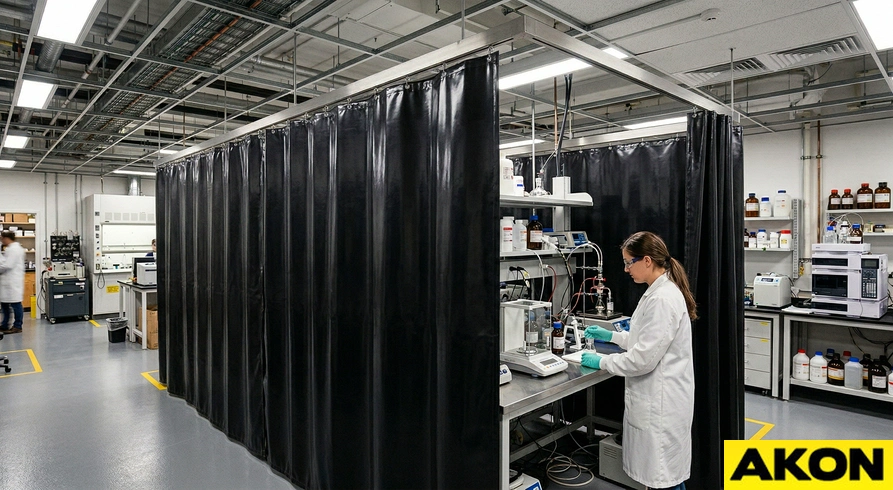
Extending Curtain Performance with ESD and Cleanroom Layers
An electrostatic discharge (ESD) layer transforms a laser blocking curtain into a dual-function barrier — containing beam radiation while simultaneously controlling static charge buildup in sensitive manufacturing environments.
The ESD layer prevents electrostatic accumulation that could compromise sensitive components during laser processing. Cleanroom-compatible layers provide a smooth, non-particulating surface suitable for controlled environments. Both options are available as add-ons to any single, double, or triple layer curtain system.
In our experience, roughly one in four laser curtain projects now include an ESD or cleanroom specification. This trend is driven by expanding use of laser micro-welding, laser marking, and laser trimming in industries where static control is a baseline requirement.
Frequently Asked Questions about Laser Blocking Curtains for Industrial and Medical Use
What laser classifications require blocking curtains?
Laser blocking curtains are needed for Class 3B and Class 4 lasers. These classifications produce radiation intense enough to cause permanent eye damage or skin burns from direct or scattered exposure. Lower-class lasers generally do not require physical barriers.
What are the available protection ratings?
Three tiers are available: single layer at 425 W/cm², double layer at 575 W/cm², and triple layer at 2,150 W/cm². All ratings are for 100 seconds of exposure, tested at 1064 nm with a 1 mm beam diameter.
Can these curtains be used for fiber laser welding?
Yes. Double and triple layer curtains are the recommended configuration for fiber laser welding environments, including handheld systems like Lightweld. Both standard and custom sizing options are available for welding cell enclosures.
How quickly can a laser curtain system be installed?
Most installations are completed in four to eight hours using ceiling or floor-mounted track hardware. Standard panels connect via hook-and-loop fasteners, and custom systems are pre-engineered to fit your exact facility dimensions.
What layout options are supported?
Track systems support curved, straight, and combination configurations. Typical layouts include room dividers, doorway partitions, workstation surrounds, table enclosures, and full laser welding cell enclosures.
Does installing curtains eliminate the PPE requirement inside the enclosure?
No. Laser blocking curtains protect personnel outside the controlled area. Anyone working inside the enclosure still needs appropriate laser protective eyewear rated for the wavelength and power density in use.
Are ESD and cleanroom add-on layers available?
Yes. Electrostatic discharge (ESD) and cleanroom layers can be added to any single, double, or triple layer curtain. These are standard options for electronics manufacturing, semiconductor processing, and controlled research environments.
What if my laser exceeds the maximum curtain rating?
For applications beyond the triple-layer rating of 2,150 W/cm², rigid panel barriers are the recommended alternative. These provide higher irradiance protection for extreme high-power laser environments.
Laser Blocking Curtain Performance Data
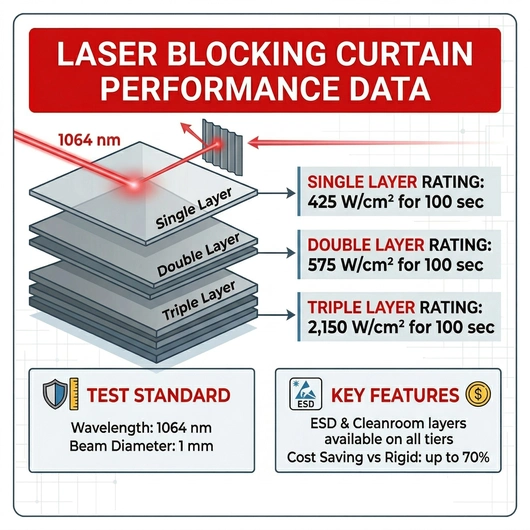
Key Specifications
- Single layer rating: 425 W/cm² for 100 sec
- Double layer rating: 575 W/cm² for 100 sec
- Triple layer rating: 2,150 W/cm² for 100 sec
- Test standard: 1064 nm, 1 mm beam diameter
- ESD and cleanroom layers: available on all tiers
- Cost saving vs rigid: up to 70%
Why Operations Teams Choose Laser Blocking Curtains
Cost Efficient
Deploy a certified laser enclosure at roughly 30% of the cost of a rigid steel or polycarbonate cabin.
Flexible Layout
Ceiling or floor-mounted track with curved, straight, and combination setups. Hook-and-loop fasteners for quick reconfiguration.
Beam Containment
Withstand direct and scattered laser energy from Class 3B and Class 4 sources, rated up to 2,150 W/cm² for 100 seconds.
Standards Compliant
Specified by qualified Laser Safety Officers. CE certified to EN 60825-4 and referenced under ANSI Z136.
ESD Protection
Optional antistatic and cleanroom layers available across all single, double, and triple layer curtain configurations.
Conclusion
When your facility operates Class 3B or Class 4 lasers, physical beam containment isn't optional — it's an engineering control requirement under ANSI Z136.1. Laser blocking curtains deliver that containment in single, double, and triple layer configurations rated up to 2,150 W/cm², at a fraction of the cost and timeline of rigid enclosures.
The combination of verified beam protection, flexible track-mounted layouts, and significant cost reduction compared to permanent enclosures makes curtain systems the practical choice for manufacturing, medical, and research environments across the United States. If your operation needs laser containment that adapts as your processes evolve, our systems are specified by Laser Safety Officers to match your exact requirements.
Need Laser Blocking Curtains for Your Facility?
We design, supply, and install custom laser blocking curtain systems for industrial, medical, and research facilities across the United States. Call us for a free consultation.
Get Your Laser Curtain QuoteAbout the Author
Rachel Simmons is an independent Industrial Laser Safety Consultant and contributing writer for AKON Curtains. With over 15 years of experience in laser containment engineering, industrial barrier design, and safety compliance for manufacturing, research, and medical facilities, Rachel Simmons specializes in ANSI Z136 compliance, beam containment system design, and laser safety program development. She has consulted on more than 500 laser curtain and enclosure projects across the United States.
Related Products
Laser Barrier
Curtains
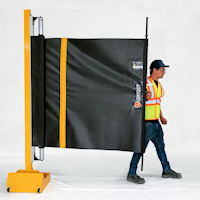
Retractable Laser
Panels
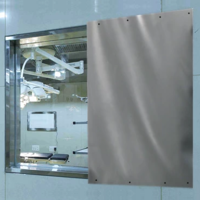
Laser Barrier
Covers
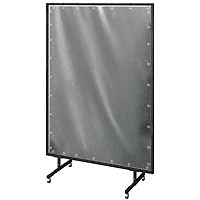
Portable Laser Curtain Barriers
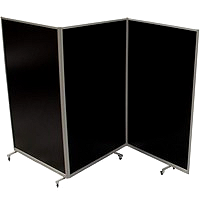
Foldable Laser
Panels
Laser Curtain
Enclosure

View All
Contains: BlogPosting + FAQPage + Organization JSON-LD.
Visible in editor only. Do not duplicate or edit manually.